

Jarosław Ziętara and the Enduring Crisis of Impunity for Crimes Against Journalists
December 14, 2025
Pakistan’s Press Freedom Crisis and the Use of Cybercrime Laws Against Journalists
December 16, 2025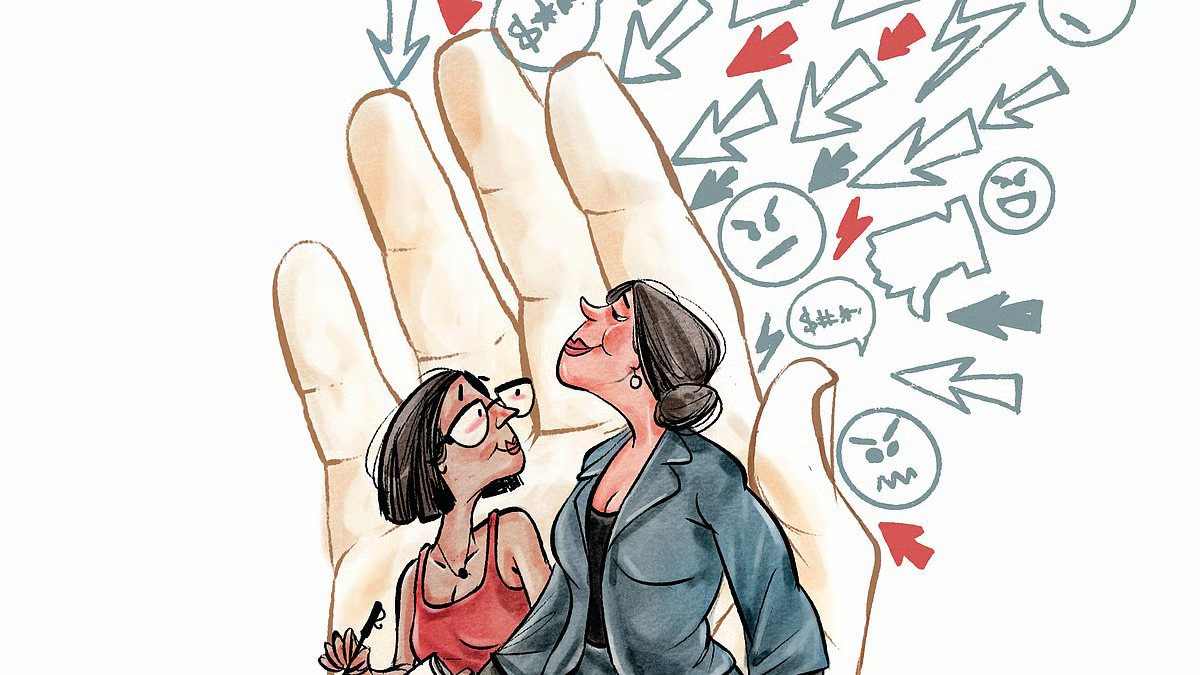
This research brief examines the structural and gendered dynamics of online harassment faced by women journalists, drawing on recent reporting that highlights why many women in the profession are unable to disengage from digital spaces without professional or personal consequences. The analysis situates online abuse not as an incidental byproduct of social media but as a sustained form of gender-based violence that directly affects press freedom, mental health, and journalistic practice.
Context and Problem Definition
Women journalists increasingly rely on digital platforms to report, build sources, distribute work, and engage audiences. However, these same platforms expose them to persistent harassment, including sexualized abuse, threats of violence, doxxing, coordinated smear campaigns, and political targeting. Unlike casual users, journalists cannot simply “log off” without risking loss of visibility, professional relevance, or audience trust.
The research identifies online abuse as an extension of offline power structures, where misogyny, political polarization, and authoritarian tactics intersect to silence women’s voices in public discourse.
Key Findings
Online Abuse as Occupational Hazard
Women journalists report that harassment is constant rather than episodic. Abuse intensifies when they cover politics, crime, gender rights, or marginalized communities. The digital environment effectively becomes an extension of the workplace, making harassment unavoidable.
Gendered Nature of Attacks
Unlike male journalists, women are disproportionately targeted with sexualized threats, character assassination, and attacks on appearance, morality, or family life. These tactics aim to discredit credibility rather than challenge reporting.
Psychological and Professional Impact
Sustained abuse leads to anxiety, burnout, self-censorship, and in some cases, withdrawal from certain beats or public-facing roles. The inability to disengage digitally exacerbates trauma and undermines career sustainability.
Platform and Institutional Failures
Social media platforms often respond slowly or inadequately to reports of abuse, particularly in non-Western contexts. News organizations also lack consistent protocols for digital safety, leaving journalists to manage threats individually.
Broader Implications
From a press-freedom perspective, digital harassment functions as a silencing mechanism that narrows whose voices are heard in journalism. When women journalists are forced to moderate their visibility or withdraw from online spaces, public discourse becomes less diverse and less representative.
The research underscores that “logging off” is not a viable solution; instead, it shifts the burden onto victims while allowing abuse to persist unchecked.
Conclusion
Online violence against women journalists is not a personal inconvenience but a systemic threat to free expression and media plurality. Addressing it requires coordinated action from newsrooms, technology platforms, policymakers, and civil society. Without structural protections, women journalists will continue to bear the cost of visibility in an increasingly hostile digital public sphere.
Reference –
https://www.newindianexpress.com/cities/chennai/2025/Dec/14/why-women-journalists-cant-log-off