
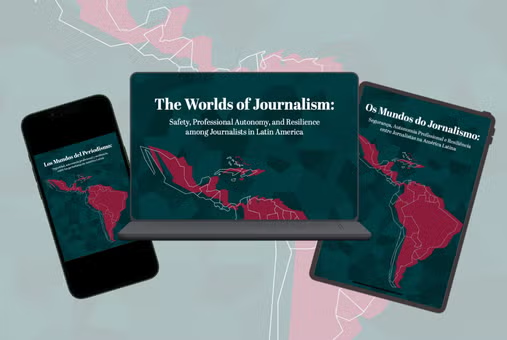
Knight Center Publishes Trilingual Ebook Based on Surveys of 4,000 Latin American Journalists
January 15, 2026
The Deadly Reality of Journalism in 2025
January 22, 2026
The targeting of Palestinian journalists in Gaza during the ongoing conflict between Israel and Palestinian armed groups has emerged as one of the most consequential threats to press freedom in a contemporary armed conflict. Independent observers, human rights groups, and media freedom advocates document that an unusually high number of journalists and media workers have been killed, injured, harassed, or barred from reporting in the territory — a pattern far exceeding typical combat-related risks faced by journalists in war zones.
Scope and Nature of Targeting
Since the resumption of hostilities in October 2023, estimates from press watchdogs place the number of journalists and media workers killed in the Gaza Strip in the hundreds, making this conflict the deadliest on record for journalists. Data compiled by multiple monitoring bodies indicate that well over 180 Palestinian journalists were reported killed by Israeli military operations as of mid-2025. Many of these deaths have occurred in contexts where media professionals were clearly identifiable and clearly engaged in journalistic activity.
In parallel, Palestinian press organisations and human rights advocates argue that the pattern of attacks on journalists and media infrastructure suggests intentional and systematic targeting rather than incidental casualties of urban warfare. They point to multiple incidents in which journalists were killed while wearing press identifications, as well as the destruction of media facilities and the curtailment of independent reporting options for foreign press.
Mechanisms of Suppression
Analysis by press freedom groups and researchers identifies several mechanisms through which journalists are targeted or obstructed:
Direct military strikes: Journalists on assignment have been killed or wounded by Israeli military fire during bombardments of civilian areas, including strikes on hospitals and residential neighborhoods. Many such attacks have resulted in high civilian mortality alongside media casualties, raising questions about proportionality and distinction under international humanitarian law.
Accusations of combatant affiliation: Israeli authorities have, at times, publicly alleged that specific journalists were affiliated with militant groups, using these claims to rationalise or justify lethal force against them. Independent investigations and press freedom organizations have challenged the evidentiary basis of these accusations and highlighted their function as a pretext to undermine the protected civilian status of journalists.
Restrictions on media access: Foreign journalists have faced barriers to independent reporting from Gaza, including strict constraints on movement and embedding with Israeli forces, effectively limiting external verification and amplifying the burden on local journalists to document events.
Narrative control and censorship pressure: Beyond physical threats, restrictions on independent reporting are compounded by efforts to control information flows, including military censorship and operational constraints on media organisations. These measures narrow the scope of independent coverage and accentuate the risks faced by journalists trying to work amidst intense hostilities.
Legal and Ethical Implications
Under international humanitarian law, journalists are explicitly recognised as protected civilians during armed conflict, and deliberate attacks on them constitute serious violations, potentially amounting to war crimes if corroborated by evidence of intent. The disproportionate casualty rates among Palestinian journalists and documented incidents where press personnel were clearly targeted have prompted calls from human rights organisations for independent investigations and accountability mechanisms.
Conclusion
The evidence across multiple independent sources suggests that the targeting of Palestinian journalists in Gaza is not solely an incidental consequence of urban warfare but also encompasses patterns of intentional suppression, restrictions on independent reporting and narrative control efforts. These conditions have made journalistic practice in Gaza extraordinarily hazardous and have significantly limited the flow of independent information from one of the world’s most contentious conflicts.
Reference –
https://www.islamicity.org/106203/why-does-israel-target-palestinian-journalists-in-gaza/