Iran Continues to Arrest Journalists Amid Intensified Crackdown on Dissent
February 2, 2026
Nepalese Journalist Deepak Sapkota to Be Honoured With Amar Nembang Memorial Award
February 2, 2026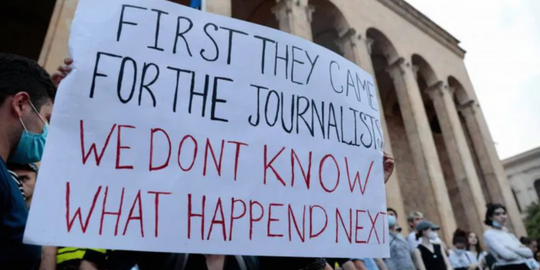
February 02, 2026 – Georgia –
A coalition of media freedom organisations has sounded urgent warnings about a new legislative package in Georgia that could substantially deepen restrictions on independent media and civil society by criminalising foreign-linked funding without prior government approval. The Media Freedom Rapid Response (MFRR) partners, supported by the International Federation of Journalists (IFJ) and others, said the proposals — fast-tracked in Parliament and expected to be adopted on 3 February 2026 — risk effectively cutting off vital funding sources for journalists and media outlets.
Under the draft amendments introduced by the Georgian Dream (GD) ruling party, virtually all foreign funding connected to public, political, or policy-oriented activities would be defined as a “grant.” Media organisations, journalists, and civil society entities that receive such funding without prior authorisation from the government could face fines, lengthy community service, and criminal penalties of up to six years’ imprisonment. Critics say this would not only shrink legitimate financial support but also deter independent reporting, research, and journalism projects that depend on external grants to operate.
The expanded definition is especially concerning for payments that support journalism-related services, research, expertise, or technical assistance by foreign actors, which could now be treated as illegal grants unless approved in advance. The legislation would also require foreign organisations to secure government permission before providing any funding to their Georgian branches or even engaging local experts.
MFRR partners argue that the amendments build on a growing body of restrictive laws introduced in Georgia since 2025, including the foreign agents law and amendments to the Laws on Freedom of Speech and Expression, Grants and Broadcasting. These laws, they say, have already undermined media independence and pluralism, contributing to a sharp rise in legal incidents affecting journalists across the country.
Independent media advocates fear the new measures would push outlets into “survival mode,” leaving them unable to sustain operations without targeted foreign assistance. Prior reporting by press freedom monitors noted that several media organisations are already struggling under existing constraints, with some operating voluntarily or with limited resources due to the clampdown on foreign funding.
Opposition groups and civil society leaders have called on the Georgian parliament to scrap the restrictive provisions and revert to more open rules that ensure independent media can function robustly — a critical component of democratic governance enshrined in Georgia’s constitution.
As the debate unfolds, international rights organisations are urging global attention on Georgia’s media landscape, warning that the new funding law could mark a significant setback for press freedom at a time when independent journalism in the country already faces mounting pressure.
Reference –
Georgia: Restrictive new funding law would further cut off media and journalists
Georgia moves to tighten restrictive media funding laws, add lengthy jail terms