Threat to Journalism Sparks Outrage in Brazil
November 24, 2025
DRC Journalist Faces Arrest Threat After Exposing Local Misconduct
November 24, 2025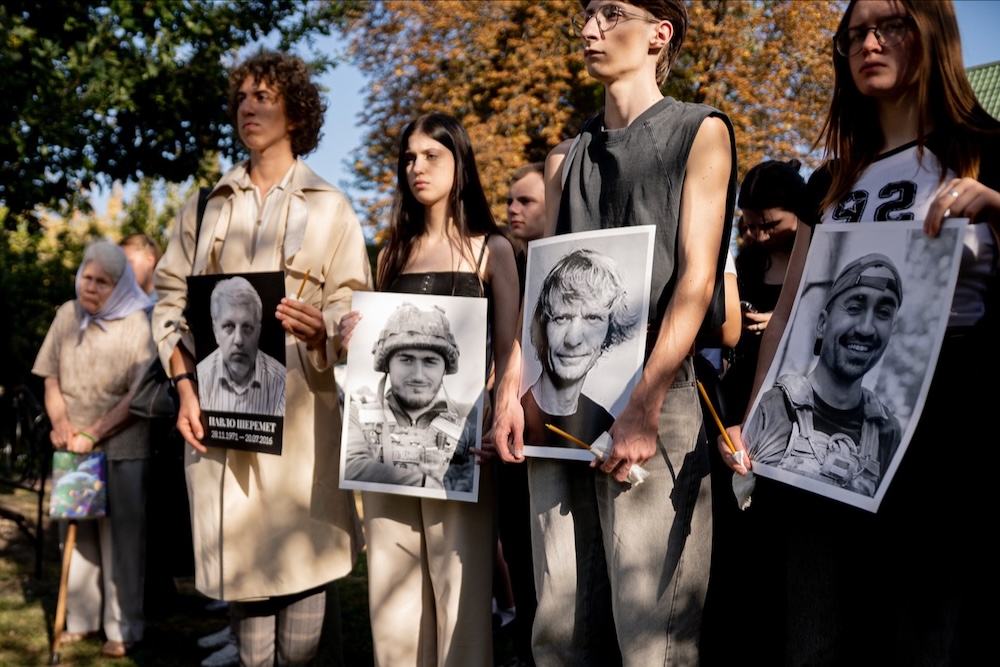
KYIV, UKRAINE - SEPTEMBER 16: People hold portraits of killed journalists on grave of Georgiy Gongadze near Mykola Naberezhny Church on 25th anniversary murder of journalist Georgiy Gongadze on September 16, 2025 in Kyiv, Ukraine. September 16 is the day to honor the memory of the Ukrainian journalist and founder of Ukrainska Pravda, Georgiy Gongadze. He disappeared in Kyiv on September 16, 2000. In November of the same year, a decapitated body was found in a forest in the Kyiv Oblast, which, according to experts, could have belonged to the journalist. As the investigation later proved, Gongadze was kidnapped by police officers and killed on the night of September 17. The perpetrators of the murder of Gongadze have still not been found or brought to justice. (Photo by Zinchenko/Global Images Ukraine via Getty Images)
November 24, 2025 – Russia/Ukraine –
A new monitoring update by the Institute of Mass Information (IMI) reports that Russian forces have committed 868 confirmed crimes against journalists and media outlets in Ukraine since the full-scale invasion began.
The latest batch of violations, recorded in October–November 2025, includes at least ten new crimes — among them an assassination attempt, armed drone strikes on reporters, attacks on television towers and newsrooms, and legal pressure exerted on media professionals. In this period alone, three media workers lost their lives: a photographer and media producer, a media-services manager turned serviceman, and a fixer affiliated with foreign media.
Since February 2022, when Russia launched its full-scale war, a total of 119 media workers have been killed — including at least 15 who died while performing their journalistic duties. In addition to lethal violence, hundreds of journalistic operations have been disrupted by strikes on infrastructure such as TV towers and media offices, while others endured shelling, drone attacks, detentions, or legal harassment.
Parallel reporting by the international network IFEX — which partners with IMI — places the tally slightly lower, citing 858 violations against the media since 2022. Regardless of the exact figure, both organisations underline a staggering escalation of danger facing media personnel in wartime conditions.
The accumulated data shows that beyond the battlefield, journalists and media outlets stand among the most consistent targets of violence, intimidation, and structural sabotage. The frequency and variety of attacks — from air-strikes to arrests to infrastructural destruction — reflect a systemic pattern designed to suppress independent reporting, propagate fear, and disrupt information flows inside Ukraine and beyond.
Given the immense human and institutional cost, media-freedom advocates argue that documenting and publicising each incident is essential — not only to honour fallen colleagues, but also to highlight persistent risks and to push for international mechanisms that protect press workers.
Reference –